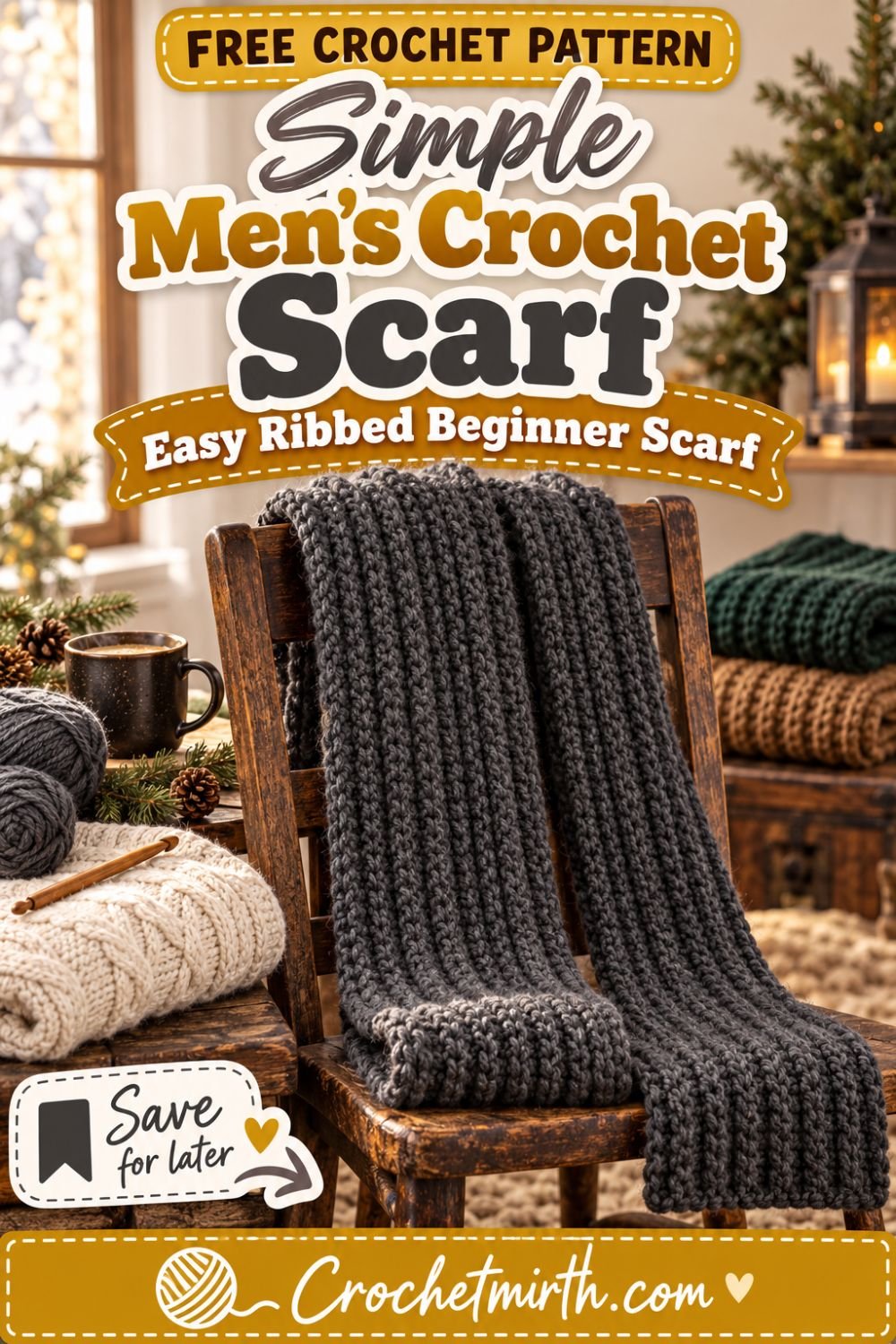
Men’s Crochet Scarf Pattern – Simple Ribbed Beginner Scarf
A good men’s scarf doesn’t need complicated stitches to look polished.
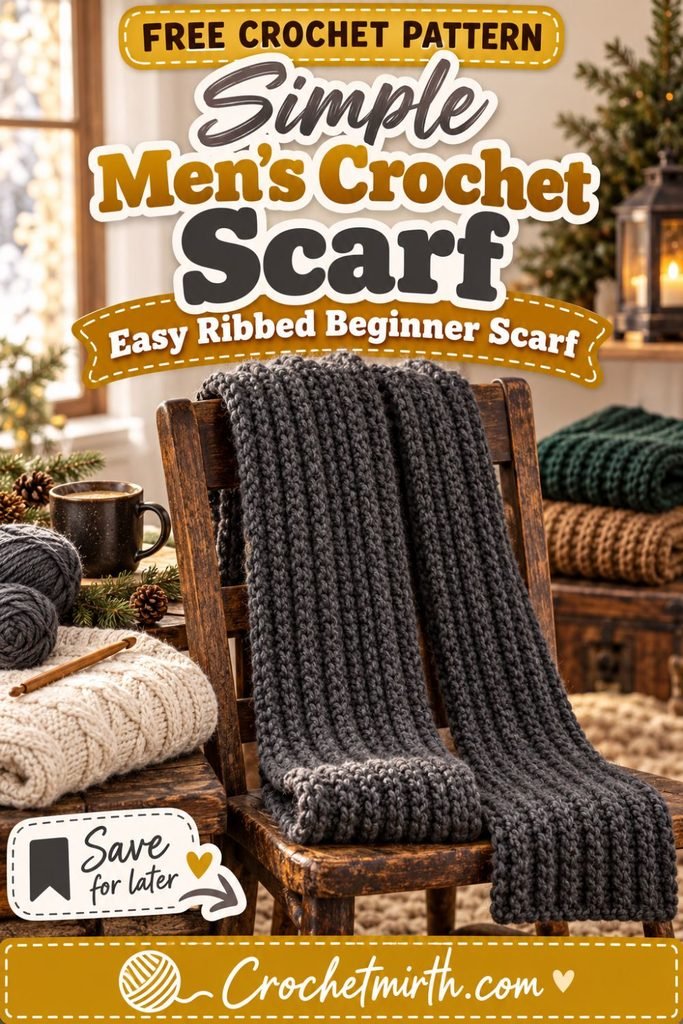
This men’s crochet scarf pattern uses one simple stitch repeat to create a warm, classic scarf with clean ribbed texture and an understated everyday style.
You’ll crochet the entire scarf flat using half double crochet in the back loop only.
There are:
- No increases
- No decreases
- No shaping
- No complicated stitch combinations
- No assembly
Just repeat the same easy row until your scarf reaches the length you want.
That makes this an excellent first scarf for beginners and a practical handmade gift for Christmas, birthdays, Father’s Day, or winter.
Why You’ll Love This Men’s Crochet Scarf
This pattern is:
- Beginner-friendly
- Made from one rectangle
- Worked completely flat
- Easy to memorize
- Made with worsted-weight yarn
- Warm without being excessively bulky
- Easy to make longer or shorter
- Naturally unisex
- Great for handmade gifts
- Simple enough for everyday wear
The ribbed stitch pattern gives the scarf texture without making the design feel overly decorative.
Skill Level
Beginner
You only need to know how to:
- Make a slip knot
- Chain
- Half double crochet
- Work into the back loop
- Turn your work
- Fasten off
- Weave in yarn ends
If you can crochet a straight row, you can make this scarf.
Materials
Yarn
Use approximately:
380–450 yards of Category 4 worsted or Aran-weight yarn
for the adult scarf.
The exact amount depends on:
- Finished length
- Gauge
- Yarn thickness
- Tension
- Whether you add fringe
For a classic men’s scarf, choose a yarn that’s soft enough to sit comfortably against the neck.
Recommended Fibers
Good choices include:
- Acrylic
- Wool/acrylic blend
- Merino wool
- Washable wool
- Soft alpaca blend
Avoid yarn that feels scratchy when rubbed against your neck.
Crochet Hook
Use a:
6.0 mm crochet hook
If your scarf feels too stiff, try:
6.5 mm
If your stitches are extremely loose, try:
5.5 mm
Other Supplies
You’ll also need:
- Yarn needle
- Scissors
- Measuring tape
- Stitch markers, optional
Crochet Abbreviations
This pattern uses US crochet terminology.
ch – chain
hdc – half double crochet
st – stitch
sts – stitches
BLO – back loop only
Finished Measurements
The sample scarf measures approximately:
7 inches wide
and:
72 inches long
This gives enough length to:
- Hang naturally
- Wrap once around the neck
- Wear under a winter coat
You can easily customize both dimensions.
Gauge
Approximate gauge:
12 hdc = 4 inches
9 rows = 4 inches
Gauge isn’t as critical for a scarf as it is for a fitted garment.
The most important measurements are:
width and finished length
Main Stitch: HDC BLO
The ribbed effect is made with:
Half Double Crochet in the Back Loop Only
Look at the top of your stitch.
You’ll see two loops forming a small V.
The loop closest to you is the front loop.
The loop farther away is the:
back loop
Insert your hook only into that back loop.
Then complete a normal half double crochet.
The unused front loop creates a raised ridge across the fabric.
Repeat this technique row after row and you’ll create a simple ribbed texture.
Why HDC BLO Works Well for a Men’s Scarf
Half double crochet is an excellent middle-ground stitch.
It’s:
- Denser than double crochet
- Faster than single crochet
- Warm
- Flexible
- Easy to memorize
Working it through the back loop creates enough texture to make the scarf interesting without needing decorative motifs.
FREE MEN’S RIBBED CROCHET SCARF PATTERN
Foundation Chain
Ch 22.
Row 1
Hdc in the second chain from your hook.
Hdc in every remaining chain.
You should have:
21 sts
Ch 1 and turn.
Row 2
Working in the:
back loop only
Hdc in every stitch across.
21 sts
Ch 1 and turn.
Row 3 and Beyond
Repeat Row 2.
Continue working:
21 HDC BLO
in every row.
Continue Until the Scarf Measures
Approximately:
70–72 inches long
or your desired length.
Depending on your personal gauge, the exact number of rows will vary.
Measure instead of relying exclusively on row count.
Fasten Off
Once your scarf reaches the desired length:
Cut the yarn.
Pull the yarn tail through your final loop.
Tighten gently.
Use a yarn needle to weave in both ends.
That’s the Entire Pattern
The construction is simply:
Chain → HDC → Repeat HDC BLO → Fasten off
No sewing is required.
Check the Width
Your scarf should measure approximately:
7 inches
across.
This creates a classic width that provides good neck coverage without becoming oversized.
Want a Narrower Scarf?
Try:
Ch 19
instead of 22.
This will create a scarf approximately:
6 inches wide
depending on gauge.
Want a Wider Scarf?
Try:
Ch 25–27
for approximately:
8–9 inches
of width.
A wider scarf will require more yarn.
How Long Should a Men’s Scarf Be?
There is no single perfect length.
A useful guide is:
Shorter scarf
60–65 inches
Classic adult scarf
68–72 inches
Tall adult or longer wrapping scarf
74–80 inches
The sample uses approximately:
72 inches
Test the Length Before Fastening Off
Drape the unfinished scarf around your neck.
Try:
- Hanging both ends straight
- One simple wrap
- Tucking it inside a coat
If it feels short, continue adding rows.
It’s much easier to adjust before fastening off.
Charcoal Gray Version
Charcoal is one of the best colors for showing the raised ribs while keeping the scarf neutral.
It pairs with:
- Black
- Navy
- Camel
- Denim
- Olive
- Brown
Forest Green Version
Deep forest green creates a subtle winter color without looking bright.
It pairs especially well with:
- Brown coats
- Camel jackets
- Cream sweaters
- Dark denim
Navy Blue Version
Navy is a classic option for a men’s winter scarf.
It works well with:
- Gray
- Black
- Brown
- Denim
Camel Brown Version
Camel or warm brown produces a timeless neutral scarf.
Heathered brown yarn can make the ribbed texture look especially rich.
Heather Gray
Heathered gray adds subtle color variation while keeping the overall design simple.
This is a good choice if you want the scarf to look textured without introducing stripes.
Black Version
Black is practical and easy to coordinate.
Choose a yarn with clear stitch definition so the ribbing doesn’t disappear visually.
Burgundy Version
Deep burgundy works well when you want a little more color while keeping the scarf understated.
One-Color Scarf
For the cleanest look:
Make the entire scarf in one solid color.
The ribbing provides all the texture you need.
Two-Color Scarf
Want subtle contrast?
Crochet most of the scarf in:
charcoal
Then make approximately the final:
8–10 inches
at each end in:
camel
or:
forest green
Color-Block Ends
You can create matching contrast sections at both ends.
For example:
Charcoal center + camel ends
Navy center + gray ends
Forest green center + cream ends
Keep the blocks simple and symmetrical.
Simple Stripes
Change yarn every:
6–10 rows
for a striped version.
For a men’s scarf, wider stripes usually create a more understated look than many narrow stripes.
Recommended Stripe Combinations
Try:
Charcoal + medium gray
Navy + cream
Forest green + charcoal
Camel + dark brown
No Fringe Version
The written pattern does not require fringe.
A clean straight edge gives the scarf:
- Modern look
- Simple finish
- Minimalist style
It’s also easier to wash and maintain.
Optional Fringe
If you’d like fringe:
Cut yarn strands approximately:
10–12 inches long
Fold each strand in half.
Pull the folded center through the scarf edge.
Bring the yarn ends through the loop.
Pull gently.
Repeat evenly across both short edges.
Keep Men’s Fringe Simple
For a more understated result:
Use relatively sparse fringe.
Avoid extremely long or thick tassels unless that’s the look you want.
Trim both edges evenly.
Best Yarn for a Men’s Crochet Scarf
Worsted Acrylic
Acrylic is practical because it’s:
- Affordable
- Widely available
- Easy to wash
- Available in many neutral colors
Choose a soft premium acrylic if the scarf will be worn directly against the neck.
Wool Blend
A wool/acrylic blend offers:
- Warmth
- Stretch
- Softness
- Durability
It’s an excellent everyday winter option.
Merino Wool
Merino can create a softer, more luxurious scarf.
It provides excellent warmth without requiring extremely thick yarn.
Alpaca Blend
An alpaca blend can create:
- Warmth
- Soft drape
- Light fuzz
Choose a blend with enough structure to maintain the ribbed texture.
Cotton?
Cotton can work, but it usually produces a heavier scarf with less insulating warmth.
For winter, wool blends or soft acrylic are generally more practical.
Why Worsted Weight Works Well
Worsted yarn provides a good balance between:
- Warmth
- Stitch definition
- Drape
- Crochet speed
It also creates a scarf that fits easily underneath most winter coats.
Current men’s ribbed scarf patterns commonly use worsted or Aran yarn with hooks around 5–6 mm.
How Much Yarn Do I Need?
For approximately:
7 × 72 inches
plan on roughly:
380–450 yards
of worsted-weight yarn.
A comparable men’s ribbed scarf pattern uses about 380 yards for a finished size near 6 × 70 inches.
Can This Be a Two-Skein Project?
Often, yes.
Many worsted-weight skeins contain around:
200–220 yards
Check your specific yarn label.
Two skeins totaling approximately:
400–440 yards
are a useful starting point.
Beginner-Friendly Stitch Repeat
One of the best things about this pattern is that after Row 1, every row is the same.
You don’t need to constantly check instructions.
Simply repeat:
HDC BLO across
That makes this a good project for:
- Watching TV
- Listening to podcasts
- Traveling
- Relaxing evening crochet
Why This Is a Good First Scarf
A beginner scarf should help you practice:
- Consistent tension
- Straight edges
- Recognizing stitches
- Turning correctly
- Counting rows
without adding unnecessary shaping.
This design does exactly that.
Keep Your Edges Straight
The most common beginner problem is accidentally adding or losing stitches.
You should always have:
21 stitches
in the written pattern.
Count every few rows.
Use Stitch Markers
Place a stitch marker into:
the first stitch
and:
the final stitch
of each row if you’re having trouble finding the edges.
Move them upward as you work.
Turning Chain
The:
ch 1
used for turning does not count as a stitch in this pattern.
Work your first HDC into the first actual stitch.
Crochet Tension
Try to maintain relaxed, even tension.
If you pull the yarn very tightly:
- Scarf may become stiff
- Ribbing may lose stretch
- Width may decrease
Scarf Too Stiff?
Try:
- Larger crochet hook
- Softer yarn
- Looser tension
A scarf should drape comfortably around the neck.
Scarf Too Loose?
If your stitches look very open:
Move down one hook size.
You still want flexibility, but the scarf should provide warmth.
Make a Thicker Winter Scarf
Use:
Category 5 bulky yarn
with approximately a:
7–8 mm hook
Crochet to the same finished dimensions.
You’ll need fewer stitches and rows.
Make a Lighter Scarf
Use:
DK yarn
with approximately a:
4–4.5 mm hook
You’ll need more stitches and more rows.
The finished scarf will be thinner and lighter.
Can I Use Single Crochet BLO?
Yes.
Single crochet BLO creates a firmer, denser rib.
The scarf will:
- Take longer
- Use more rows
- Feel slightly thicker
Can I Use Regular HDC?
Yes.
Work under both loops instead of only the back loop.
You’ll get a smoother scarf with less visible ribbing.
Can I Use Double Crochet?
Yes, but double crochet creates larger openings.
For a classic winter scarf, HDC gives a better balance of:
- Warmth
- Speed
- Texture
Make a Matching Men’s Beanie
Use the same yarn as your Crochet Beanie Pattern for Men.
A matching beanie and scarf set makes a practical handmade winter gift.
Choose:
charcoal
navy
or:
forest green
for an easy coordinated look.
Matching Gift Set
Pair the scarf with:
- Ribbed beanie
- Gloves
- Warm socks
- Travel mug
Wrap everything together for a handmade Christmas or birthday gift.
Handmade Christmas Gift
This scarf is particularly useful as a gift because there’s almost no sizing risk.
Choose a versatile neutral shade.
Fold it lengthwise.
Roll gently.
Wrap with a kraft-paper band.
Add a simple tag:
Handmade for You
Father’s Day Gift
Even though this is designed as a winter scarf, you can crochet it ahead of time as a Father’s Day handmade gift.
Choose:
- Charcoal
- Navy
- Brown
- Forest green
Birthday Gift
Because the design is timeless, you don’t have to reserve it for Christmas.
It works for:
- Birthdays
- Winter celebrations
- Graduation gifts
- Everyday handmade gifts
Personalize the Scarf
You don’t need complicated embroidery.
A simple color choice can make the scarf feel personal.
Choose:
- Favorite color
- School colors
- Team-inspired colors without logos
- Coat-matching neutral shade
Optional Initial
If you’d like subtle personalization:
Embroider a small initial near one lower corner.
Keep it discreet.
Make It Extra Long
For someone tall or someone who likes wrapping scarves several times:
Continue to approximately:
78–82 inches
Plan for additional yarn.
Make It Shorter
For a simple under-the-coat scarf:
Stop at approximately:
60–64 inches
Wider Scarf
For more neck coverage:
Increase the starting chain to approximately:
25–27 chains
and continue as written.
Narrower Scarf
For a slimmer dress-style scarf:
Try approximately:
18–19 chains
Check the finished width before continuing too far.
Blocking the Scarf
Blocking can help:
- Straighten the edges
- Relax the ribbing
- Improve drape
- Even out minor tension differences
Use the blocking method appropriate for your yarn.
Don’t Overstretch During Blocking
The ribbing should remain visible.
Stretching the scarf too aggressively can flatten the texture.
Washing Your Scarf
Always follow the yarn manufacturer’s instructions.
In general:
- Wash gently.
- Avoid excessive heat.
- Support the scarf while wet.
- Reshape.
- Lay flat to dry when recommended.
Avoid Hanging While Wet
A long wet scarf can become heavy.
Hanging it while saturated may stretch the fabric lengthwise.
Storing the Scarf
Fold it rather than leaving it hanging for months.
This helps preserve the shape.
Common Beginner Mistakes
Losing Stitches
The written scarf should have:
21 stitches per row
Count regularly.
Crocheting Into Both Loops
That will still create a scarf, but the ribbing will be less pronounced.
Skipping the Final Stitch
The final stitch can be harder to see.
Use a marker if needed.
Making the Foundation Chain Too Tight
A tight foundation can make one edge narrower than the rest.
Try chaining loosely.
Changing Hook Size Mid-Project
Use the same hook throughout unless intentionally adjusting gauge.
Running Out of Yarn
Check your total yardage before starting.
Scarf Becoming Wider
This usually means you’ve accidentally added stitches.
Stop and count before continuing.
Frequently Asked Questions
Is this pattern suitable for complete beginners?
Yes. After the foundation row, you repeat the same basic HDC BLO row.
What yarn weight does it use?
Category 4 worsted or Aran-weight yarn.
What hook size is used?
6.0 mm.
How wide is the scarf?
Approximately 7 inches.
How long is it?
Approximately 72 inches.
How much yarn do I need?
Approximately 380–450 yards.
Does it need fringe?
No. Fringe is completely optional.
Is the scarf worked lengthwise?
No. The written version uses short rows across the scarf width and continues until the desired length is reached.
Can I make it wider?
Yes. Increase the foundation chain.
Can I make it longer?
Yes. Simply add more rows.
Is this pattern only for men?
No. The clean ribbed design is naturally unisex, but the dimensions, styling, and color suggestions are chosen for a classic men’s scarf.
Final Thoughts
Simple crochet can still look polished.
This men’s crochet scarf pattern uses nothing more complicated than half double crochet worked through the back loop, but that small change creates a clean ribbed texture that gives the scarf a classic winter look.
Make it in charcoal for an easy everyday neutral.
Choose navy for a traditional style.
Try forest green for a subtle winter color.
Or use camel or brown for a warm, timeless finish.
Because there is no shaping and every row follows the same repeat, it’s also a great project for beginners who want to practice consistent stitches while creating something genuinely useful.
Pair it with a matching ribbed beanie for a complete handmade winter gift.
Save this simple men’s ribbed crochet scarf pattern for your winter project list!