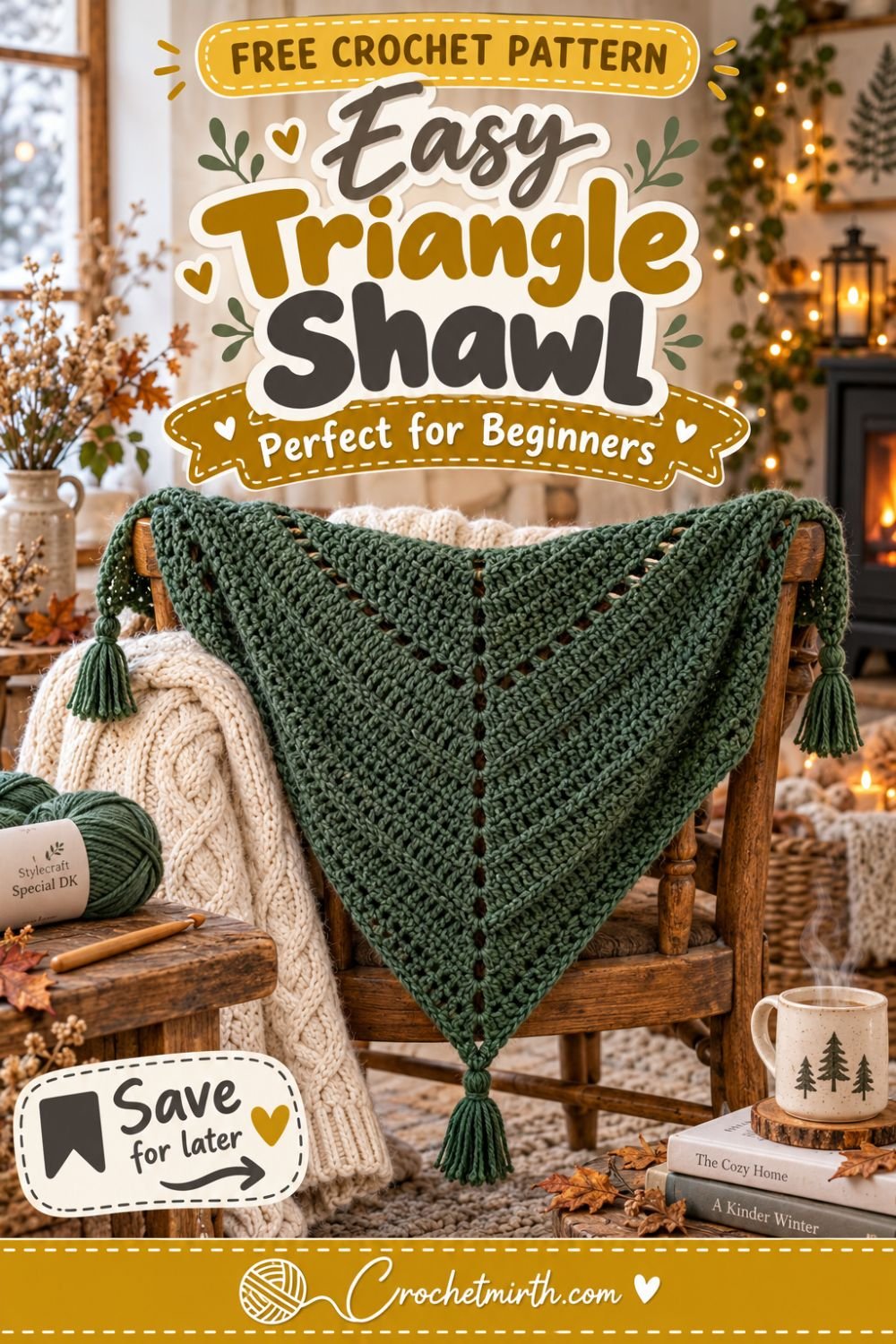
Easy Crochet Shawl Pattern – Simple Triangle Shawl for Beginners
If you’ve been wanting to crochet your first shawl, this easy crochet shawl pattern is a wonderful place to start.
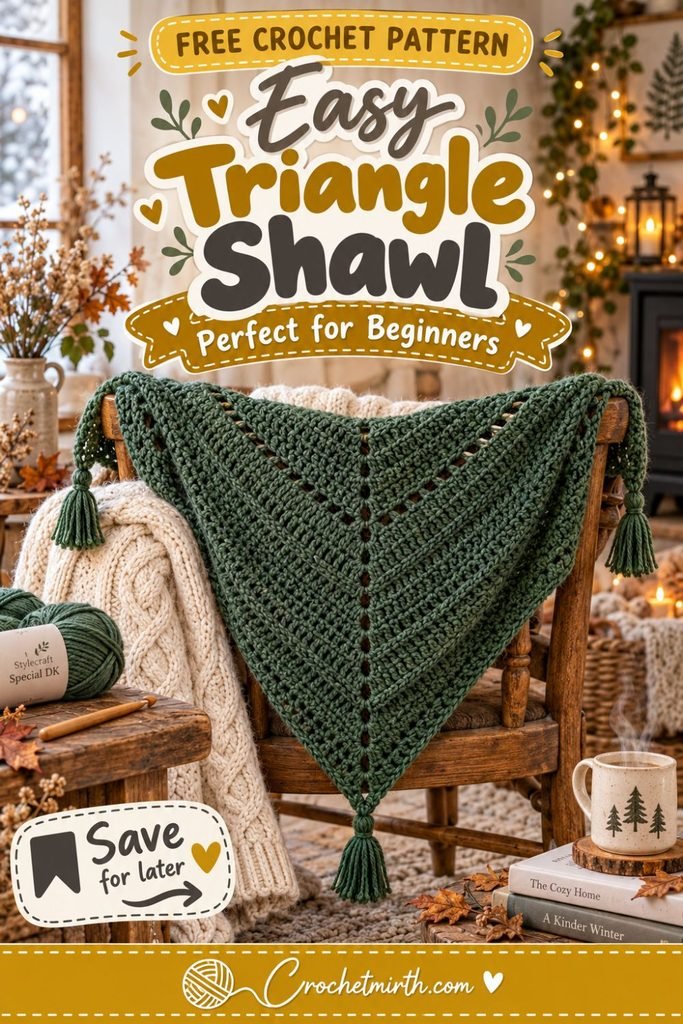
The shawl is worked from the top center outward, gradually growing into a classic triangle.
You don’t need complicated stitch combinations or difficult shaping. The main pattern uses basic double crochet stitches, with simple increases along the outside edges and at the center of the shawl.
Once you understand the repeat, you can keep crocheting until your shawl is exactly as large as you want.
Make it as a lightweight shoulder wrap, a cozy oversized shawl, or even a large triangle scarf.
Why You’ll Love This Crochet Triangle Shawl
This shawl is:
- Beginner-friendly
- Worked in one piece
- Made with basic stitches
- Easy to memorize
- Simple to resize
- Seamless
- Beautiful in solid or gradient yarn
- Suitable for fall and winter
- Great for handmade gifts
- Easy to customize with fringe or tassels
The repeating rows also make this a relaxing project once you understand where the increases go.
Skill Level
Beginner / Easy
You should know how to:
- Make a slip knot
- Chain
- Double crochet
- Slip stitch
- Work into a chain space
- Turn your work
- Fasten off
- Weave in ends
Materials
Yarn
Approximately 650–750 yards of DK / Category 3 yarn
For a larger shawl, have extra yarn available.
Good fibers include:
- Acrylic
- Merino wool
- Wool blends
- Acrylic/wool blends
- Cotton blends
- Alpaca blends
Choose a yarn with good drape so the finished shawl falls softly around your shoulders.
Crochet Hook
5.0 mm crochet hook
Using a hook slightly larger than the minimum recommended for your yarn can help create softer, more flowing fabric.
Other Supplies
- Yarn needle
- Scissors
- Measuring tape
- Stitch marker, optional
- Blocking mats and pins, optional
Crochet Abbreviations
This pattern uses US crochet terminology.
ch – chain
dc – double crochet
sl st – slip stitch
st – stitch
sts – stitches
sp – space
ch-2 sp – chain-2 space
Finished Size
Approximate finished dimensions:
Wingspan: 64–68 inches
Depth: approximately 30–32 inches
The size is completely customizable.
Simply stop earlier for a smaller triangle scarf or continue adding rows for an oversized shawl.
Gauge
Gauge is not critical for this pattern.
A useful approximate gauge is:
14 dc = 4 inches
The most important thing is creating fabric that:
- Drapes comfortably
- Isn’t too stiff
- Has clearly defined stitches
- Feels pleasant around your shoulders
How This Triangle Shawl Grows
You’ll start at the top center of the shawl.
Every row becomes wider because we add stitches in three places:
- At the beginning of the row
- In the center chain space
- At the end of the row
The center increase creates the pointed triangle shape.
Once you recognize the center ch-2 space, the pattern becomes very repetitive.
Easy Crochet Triangle Shawl Pattern
Starting Ring
Ch 4.
Join with a sl st into the first chain to create a small ring.
Row 1
Ch 3.
The ch 3 counts as the first dc.
Work 2 dc into the ring.
Ch 2.
Work 3 dc into the ring.
Turn.
You now have two small groups of double crochet separated by a center ch-2 space.
Row 2
Ch 3.
This counts as the first dc.
Work 1 dc in the same first stitch.
Dc in each stitch until you reach the center ch-2 space.
In the center ch-2 space work:
2 dc, ch 2, 2 dc
Dc in each remaining stitch across.
Work 2 dc in the final stitch.
Turn.
Row 3
Ch 3.
Dc in the same first stitch.
Dc in every stitch until you reach the center ch-2 space.
In the center space work:
2 dc, ch 2, 2 dc
Continue with dc in every stitch across.
Work 2 dc in the final stitch.
Turn.
Row 4 and Beyond
Repeat Row 3.
Every row follows the same structure:
Increase at beginning → dc across → center increase → dc across → increase at end
Continue until the shawl reaches your desired size.
Easy Row Formula
For every row:
Beginning
Ch 3.
Dc in the same first stitch.
First Side
Dc in every stitch until the center.
Center
Work:
2 dc, ch 2, 2 dc
into the ch-2 center space.
Second Side
Dc in every stitch across.
Final Stitch
Work:
2 dc
in the final stitch.
Turn.
Repeat.
How to Find the Center
The center is always the:
ch-2 space
from the previous row.
If you’re worried about losing it, place a stitch marker inside that space.
Move the marker upward after every row.
This can be very helpful when you’re learning.
How Large Should the Shawl Be?
Continue the pattern until the top edge measures approximately:
64–68 inches
for a generously sized adult shawl.
The center point should measure roughly:
30–32 inches
from the top center to the bottom tip.
These measurements are only suggestions.
You can make the shawl any size you prefer.
Small Triangle Scarf
For a smaller scarf-style version, stop when the wingspan measures approximately:
45–50 inches
This creates a triangle that can be wrapped around the neck.
Medium Shawl
For a comfortable everyday shawl, aim for approximately:
58–62 inches
across the top.
Oversized Shawl
For a dramatic wrap, continue until the wingspan is:
70 inches or more
Just make sure you have enough yarn.
Optional Simple Border
Once the main triangle reaches the size you want, you can leave it exactly as it is.
Or add a simple border.
Border Row 1
Ch 1.
Work sc evenly along the first angled edge.
At the bottom point, work:
3 sc
into the center space.
Continue sc evenly along the second angled edge.
Fasten off.
This creates a neat clean finish.
Optional Decorative Border
For a slightly more open edge, try:
sc, ch 2, skip 1 stitch
repeated along the border.
At the bottom point, work:
sc, ch 3, sc
to maintain the point.
This creates a simple eyelet-style edge without making the shawl overly decorative.
Add Tassels
Three tassels look especially pretty on a triangle shawl.
Attach one tassel to:
- Left corner
- Bottom point
- Right corner
How to Make a Tassel
Wrap yarn around a piece of cardboard approximately:
20–30 times
depending on how full you want the tassel.
Cut the yarn along one end.
Tie another strand tightly around the center.
Fold the bundle in half.
Wrap yarn several times around the top to form the tassel head.
Trim the bottom evenly.
Attach it securely to the shawl.
Add Fringe
Instead of tassels, you can add fringe along both diagonal edges.
Cut yarn strands approximately:
10–12 inches
long.
Take two strands at a time.
Fold them in half.
Use your crochet hook to pull the folded center through an edge stitch.
Pull the loose ends through the loop.
Tighten gently.
Repeat evenly along both sides.
Keep It Minimal
Fringe and tassels are optional.
Without them, the shawl has a simple contemporary look.
A solid-color shawl with a clean border can be just as beautiful.
Why Double Crochet Is Great for Beginners
Double crochet is taller than single crochet.
That means your shawl grows faster.
It also creates fabric with:
- More movement
- Better drape
- Slightly more openness
- Less stiffness
Those qualities work especially well for wraps and shawls.
Best Yarn for a Triangle Shawl
DK Yarn
DK is a great balance between:
- Warmth
- Drape
- Stitch definition
- Comfortable weight
It creates a shawl that’s substantial without becoming extremely heavy.
Worsted Weight Yarn
Worsted yarn creates a warmer shawl.
Use a slightly larger hook if necessary to keep the fabric soft.
Fingering Weight Yarn
For a lightweight, elegant shawl, use fingering yarn.
You’ll need more rows and more crochet time, but the finished fabric will have beautiful drape.
Gradient Yarn
Triangle shawls are excellent projects for gradient or self-striping yarn.
Because each row becomes longer, the color transitions spread naturally across the shawl.
Try:
- Green to cream
- Burgundy to blush
- Navy to pale blue
- Rust to mustard
- Charcoal to light gray
Solid Colors
Solid yarn helps highlight the simple stitch structure.
Great fall and winter colors include:
- Forest green
- Burgundy
- Mustard
- Rust
- Camel
- Chocolate brown
- Cream
- Charcoal
- Navy
- Sage green
Make a Striped Shawl
Change colors every:
2–6 rows
for easy stripes.
You can alternate two colors or use leftover yarn.
For example:
Forest green + cream
Mustard + rust
Sage + warm gray
Burgundy + blush
Use Your Yarn Scraps
A large triangle shawl can also become a stash-busting project.
Change colors whenever one ball runs out.
Because the basic stitch pattern remains the same, you can focus entirely on creating your color sequence.
How to Make the Shawl Warmer
For a warmer winter wrap:
- Use wool or a wool blend
- Choose worsted-weight yarn
- Use a slightly smaller hook
- Make a larger shawl
- Add a dense single crochet border
How to Make It Lighter
For a spring or summer version:
- Use cotton or cotton blend
- Choose DK or fingering yarn
- Use a slightly larger hook
- Add more chain spaces
- Skip fringe
How to Wear a Triangle Shawl
There are several easy ways to style it.
Classic Shawl
Place the center point down your back.
Bring both wings over your shoulders.
Triangle Scarf
Place the point at the front of your chest.
Wrap the two wings around your neck.
One-Shoulder Wrap
Drape the shawl across your shoulders and bring one end over the opposite shoulder.
Belted Wrap
Drape the shawl around your shoulders and add a belt around your waist.
This turns a simple shawl into a more structured layering piece.
Handmade Gift Idea
A triangle shawl makes a beautiful handmade gift because sizing is forgiving.
Unlike:
- Sweaters
- Gloves
- Hats
you don’t need an exact body measurement.
Choose a soft yarn in the recipient’s favorite color.
Fold the shawl neatly and wrap it with:
- Cream ribbon
- Velvet ribbon
- Natural twine
Add a handmade label for a polished finish.
Make a Matching Set
Use leftover yarn for:
- Fingerless gloves
- Ear warmer
- Simple beanie
A shawl with matching fingerless gloves makes a cozy fall or winter gift set.
Why This Pattern Is Good for Beginners
Some shawl patterns include:
- Complicated lace charts
- Many special stitches
- Difficult decreases
- Long stitch repeats
This pattern avoids those techniques.
You repeat the same basic structure on every row.
The only places you really need to remember are:
Beginning → center → end
Once that becomes familiar, the pattern is very relaxing.
Common Beginner Mistakes
Losing the Center Space
The most important point in the pattern is the center ch-2 space.
Use a marker if needed.
Forgetting an Edge Increase
Remember:
At both outside edges you work 2 dc.
Missing one can cause the shawl to lean or become uneven.
Forgetting the Center Increase
Always work:
2 dc, ch 2, 2 dc
into the center space.
This is what creates the triangle point.
Crocheting Too Tightly
A shawl should have soft drape.
If your fabric feels stiff:
- Relax your tension
- Or use a larger hook
Not Counting Occasionally
You don’t need to count every row forever, but count periodically.
Both sides of the triangle should remain symmetrical.
How to Fix an Uneven Triangle
Lay the shawl flat.
Check whether both sides are approximately the same length.
If one side appears noticeably shorter, you may have missed an increase.
If the mistake is recent, undo the rows and correct it.
Small differences can often be improved during blocking.
Blocking the Finished Shawl
Blocking can dramatically improve a triangle shawl.
It helps:
- Open the stitches
- Sharpen the center point
- Straighten the top edge
- Improve drape
- Even out the overall shape
How to Block
Choose a blocking method suitable for your yarn.
Lay the shawl flat.
Gently stretch the top edge straight.
Shape both diagonal sides evenly.
Pin the three points if necessary.
Allow the shawl to dry completely.
Can I Make This With One Skein?
That depends on the skein size.
Some large gradient cakes contain 500–600+ yards, which may be enough for a smaller shawl.
For the full-size version in this article, plan for approximately:
650–750 yards
to be safe.
How Long Does a Crochet Shawl Take?
That depends on:
- Yarn thickness
- Finished size
- Crochet speed
- Experience
The early rows are very quick.
As the shawl grows, each row becomes longer.
The repetitive pattern makes it ideal for working a few rows at a time over several evenings.
Can Complete Beginners Make This Shawl?
Yes.
If you know:
- Chain
- Double crochet
you already know almost everything needed.
The main new skill is learning where to place the increases.
A stitch marker in the center makes this even easier.
Can I Use a Different Yarn Weight?
Yes.
This pattern is easy to adapt.
Thinner Yarn
Use:
- Smaller hook
- More rows
You’ll create a lighter shawl.
Thicker Yarn
Use:
- Larger hook
- Fewer rows
You’ll create a chunkier winter shawl.
Instead of relying on row counts, crochet until you reach your desired measurements.
Can I Make the Triangle Wider?
Yes.
Continue adding rows.
Each new row increases the wingspan.
Can I Make It Shallower?
For a shallower triangle, you would need a different increase structure.
For this beginner version, I recommend keeping the standard triangle construction and simply stopping when you like the size.
Frequently Asked Questions
Is this shawl worked in one piece?
Yes. The entire main shawl is worked continuously in rows.
Is there any sewing?
No sewing is required for the basic shawl.
How does the triangle shape form?
Increases are made at both outer edges and in the center ch-2 space.
Can I make it larger?
Yes. Simply continue repeating the main row.
Can I leave off the border?
Absolutely.
Can I use gradient yarn?
Yes. Gradient and self-striping yarns work beautifully with triangle shawls.
Is the pattern beginner-friendly?
Yes. It uses mostly chain and double crochet stitches with a simple repeating increase structure.
Final Thoughts
A triangle shawl is one of the best projects for learning how simple crochet increases can create an entire garment shape.
With this easy crochet shawl pattern, you begin with just a tiny center ring.
Then every row grows naturally outward through easy increases at the edges and center.
There is no complicated sewing, no fitted sizing, and no difficult stitch repeat to memorize.
Keep it simple in one beautiful color, use gradient yarn, add tassels, or create stripes from your leftover yarn.
Make it small enough to wear as a triangle scarf or continue until it becomes a large cozy wrap.
Save this simple triangle crochet shawl pattern for your next relaxing beginner project!